
Home > Blow Mould For All Package
Custom Online Blow Molding Package Mold Services
With over a decade of experience in the mold industry and advanced blow molding equipment, Booling ensures that the blow-molded package produced have uniform wall thickness and consistent height.
What are Blow Mould Services?
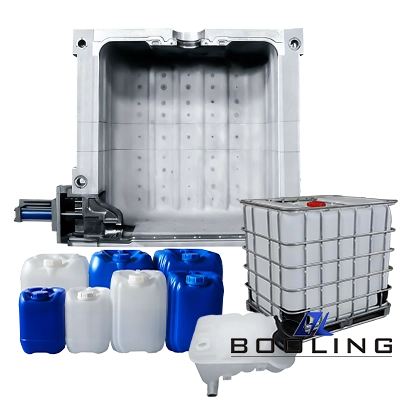
A blow mold is a mold used in the blow molding process. It typically consists of two halves made of metal, with the product’s shape engraved on the inner cavity. This type of mold is used to manufacture hollow plastic products, such as IBCs.
During the process, the material (such as plastic) is first formed into a tube-like shape, also known as a parison. The parison is then clamped between the two mold halves. Compressed air is injected into the parison through a blowing port located at the top of the mold using a blow molding machine. The air pressure forces the parison to expand and tightly conform to the inner surface of the mold cavity. Once cooled, the blow-molded product is formed.
The Booling Assurance
Global Services
Access Booling's full manufacturing capabilities instantly. Wherever you are, we deliver solutions backed by technical expertise and global experience.
Available for immediate inquiry
Booling's intelligent system provides instant design assessment, delivering an accurate quote and reliable lead time—all within minutes.
Quality Assurance
Operating under ISO 9001:2015 and strict NDAs, our system provides clear visibility into project quality and progress—keeping your ideas fully secured.
Main Industries Using
Chemical Industry
Used for the storage and transportation of various chemical raw materials, acids, alkalis, solvents, intermediates, lubricants, coatings, etc.

Food & Beverage Industry
Can be used for the storage and transportation of beverages, frozen foods, seafood, vaccines, etc., at low temperatures, and keeping certain raw materials and chemicals within specific temperature ranges.

Coatings/Paint Industry
Can be used for the storage and transportation of water-based coatings, solvent-based paints, resins, etc.

Daily Chemical Industry
Can be used for the storage and transportation of pesticides, liquid fertilizers, foliar fertilizers, etc.

Pesticides/Agriculture
Can be used for the storage and transportation of detergents, surfactants, cosmetic raw materials, etc.
Materials Used
High-Density Polyethylene (HDPE)
It is the most commonly used material, offering good rigidity, chemical resistance, and strong environmental stress cracking resistance (ESCR).
Suitable for producing IBCs, 200L drums, fuel tanks, etc.
Polypropylene (PP)
Good heat resistance (hot-fillable), high stiffness, good transparency.
Suitable for producing hot-fill beverage bottles, food containers, etc.

Dimensional accuracy
| Model | Overflow Capacity | Dimension(mm) | Weight(kg) |
|---|---|---|---|
| 5L | ≥5L | 185×185 × 260 | 0.35-0.40kg±0.05kg |
| 10L | ≥10L | 225×225×350 | 0.60-0.70kg±0.05kg |
| 25L | ≥26L | 300×200×450 | 1.30-1.50kg±0.10kg |
| 50L | ≥52L | 400×400×580 | 2.50-2.80kg±0.15kg |
| 100L | ≥105L | 450×450×750 | 4.50-5.00kg±0.20kg |
| 120L | ≥125L | 500×500×800 | 5.20-5.80kg±0.25kg |
| 200L | ≥215L | 590×590×920 | 8.50-9.50kg±0.30kg |
| 500L | ≥523L | 1200×1000×1150 | 28.0-32.0kg±1.0kg |
| 1000L | ≥1050L | 1200×1000×1160 | 56kg-62kg±3kg |
| 2000L | ≥2100L | 1200×1000×2100 | 95.0-105.0kg±5.0kg |
Why Choose Us
Tight tolerance
As an innovator who has been deeply involved in blow molding technology for many years, Booling has always been committed to providing customers with high-precision products within a tolerance of ±0.01mm through parameter optimization, mold design, and material science breakthroughs, while achieving a perfect balance between production efficiency and product performance.
Precision by Design
We combine CAE simulation with measured data to reserve shrinkage margins during the mold design phase to ensure that the final dimensions match the drawings by more than 99%.
Quality Guarantee
Visual Quality Check
Drop Test
Stacking Test
Customization Services
Color customization
Logo Printing Service
Cleaning and Reuse Performance
Easy to clean and reusable multiple times.
Minimum Order Quantity(MOQ)
1 set
Lead Time
20-50 days
Testing Methods for Blow Molded Drums
Visual Inspection
Test Objective: To ensure the barrel is free from obvious defects, meets the requirements for use, and maintains an aesthetically pleasing appearance.
Test Method: Visual inspection under natural light or artificial lighting, supplemented by measurement tools such as calipers and wall thickness gauges.
- Acceptance Criteria:Appearance: No sand holes, no poor plasticization, and the outer wall must be smooth and clean.
- Impurities: Length should not exceed 4mm and must not penetrate the barrel wall.
- Flash: No sharp burrs; must be neatly trimmed.
- Bung Opening: The lid must fit tightly and securely. Lids should have good interchangeability, meaning any lid can seal any barrel tightly.
- Barrel: The wall thickness ratio at symmetrical parts of the barrel must not exceed 2:1.
- Printing/Logo: Patterns or logos must be clear, without peeling or blurring.
Stacking Test
Test Objective: To simulate the compressive strength and stability of the container under warehouse stacking conditions.
Test Standards: GB/T 13508, SN/T 0271, UN Recommendations on the Transport of Dangerous Goods.
Test Method:
- Test Conditions: Place the sample in an environment at approximately 40°C.
Stacking. - Duration:Ordinary goods: 7 days ; Dangerous goods: 28 days.
- Stacking Height: 3m。
- Stack Load Calculation:
> Stack load = (Stacking height / Individual container height – 1) × Gross mass of a single container (container weight + contents, kg)
> (Note: The values for stacking height and individual container height shall be rounded up to the nearest integer.)
Acceptance Criteria:
- The sample shows no collapse.
- No leakage of the contents occurs.
- No significant deformation of the container (deformation rate ≤ 3%).
Drop Test
Test Objective: To simulate the impact of drops that may occur during transportation and handling, thereby testing the impact resistance and sealing performance of the container.
Test Standards: GB/T 13508, SN/T 0271, UN Recommendations on the Transport of Dangerous Goods.
Test Method:
- Temperature Conditioning: Place the sample in a -18°C environment for 24 hours.
- Drop Height:For contents with density ≤ 1.2:
- Ordinary liquids: 0.8m
- Class II/III dangerous goods: 1.2m
- For contents with density > 1.2 ; Ordinary liquids: 0.67m × density
Acceptance Criteria:
- The sample shows no rupture or damage.
- No leakage of the contents occurs.
- The lid is not loose and does not detach.

Other materials used in blow molding
- LDPE
- LLDPE
- PET
- PS
- PA/NYLON
- POM
- PPS
- PVC
- PC

HDPE Blow Molding Principle
In Booling’s view, blow molding is not a simple “heating-inflation-cooling” process, but a systematic project that requires multi-dimensional coordination. Our technical team intervenes in the control from the raw material selection stage:
Raw Material Preparation
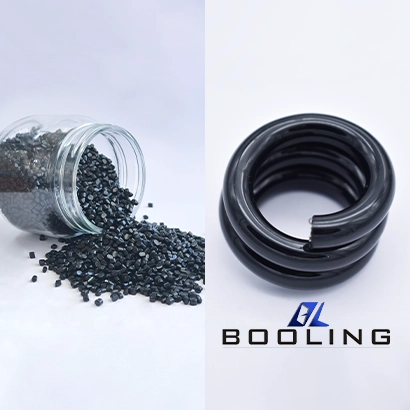
According to the mechanical requirements of customer products (such as tensile resistance or environmental stress cracking resistance), we select HDPE particles with different melt flow index (MFI) and molecular weight distribution, and eliminate moisture interference through pre-drying treatment.
Parison Extrusion
Put the prepared raw materials into the extruder, and melt and extrude the raw materials into a tubular parison through the rotation of the screw. At this time, Booling’s engineers will pay attention to parameters such as temperature and screw speed to ensure the quality of the parison.
Mold Closing
Put the extruded parison into the blow mold quickly and clamp it.
Blow Molding
Introduce compressed air to expand the parison and fit the inner wall of the mold.

It is particularly worth emphasizing that our ability to predict shrinkage and handle deformation has become the key reason for customers to choose Booling. HDPE will shrink anisotropically after cooling (differences in shrinkage rates in length, width, and thickness). We combine CAE simulation with measured data to reserve shrinkage margins during the mold design phase to ensure that the final dimensions match the drawings by more than 99%.
Regarding issues with blow molding packaging
If the cooperation goes well, can you supply the product on a long-term basis?
Yes, we can supply the products on a stable and long-term basis.
If we need the products urgently, can you expedite the shipment?
Yes, that’s possible.
Do you provide free samples or paid sampling?
Yes,We can provide free samples or paid sampling services .
Can you send us real videos showing the drop, stacking, and air tightness tests?
Certainly. We can record and send you the videos of those tests.
