
Home > Home Appliance Mold > Rice Cooker Mold
Rice Cooker Mold
Details
Model:
Booling-Rice Cooker Mold-1
Mold Steel:
45#, P20, 718, 2738, H13, SKD11, S136, 7075AL, 6065AL, beryllium bronze, etc.
Plastic Material:
PP/ABS/PC
Mold Base:
LKM, Booling standard
Origin:
China
Application:
- Rice Cooker Mold
- Injection Molding
Related Hot Products
Technical Parameters Of Rice Cooker Mold
When producing rice cooker molds, it is necessary to focus on the changes in parameters to ensure higher surface quality.
| Number of cavities | 1 or multi-cavity |
|---|---|
| Process type | Injection molding |
| Steel hardness | HRC28-HRC60 |
| Mold heat treatment | Vacuum quenching, tempering, nitriding, etc. |
| Mold life | 500,000-2,000,000 times |
| Mold size | Depends on rice cooker design and injection machine |
| Mold weight | Depends on rice cooker design and injection machine |
| T1 | 30-60 days |
| Processing method | Grinding machine, drilling machine, CNC, EDM, high-speed finishing, deep hole drilling, wire cutting, etc. |
| Design software | AutoCAD, UG, Moldflow |
| 3D drawing format | Stp, x-t, prt, etc. |
| Injection runner | Cold runner/hot runner |
| Injection gate | Direct gate, point gate, latent gate, fan gate, bull-horn gate, etc. |
| Sample quantity | 3-5 pieces |
| Processable surface roughness | 0.8μm |
| Dimensional accuracy | ±0.02mm |
| Quotation method | Send samples, send sample pictures and dimensions, rice cooker 3D drawings. |
| Mold packaging | Wooden box |
| Mold accessories | Free |
| MOQ | 1 piece |
| Ejection method | Ejector, stripper, etc. (using hydraulic, cylinder, air valve, etc.) |
| Price Term | FOB, CIF |
Materials for manufacturing molds and plastic parts
It is the optimal steel option for molds of rice cooker outer casings and bases. Featuring excellent machinability and competitive cost, it allows easy welding and repair during subsequent engineering modifications.
It becomes the preferred material for rice cooker molds requiring superior polishing finish or extended service life.
This grade of steel is applied to hot runner manifolds and continuously heated mold inserts.
Selected for mold cavities where corrosive plastics (e.g., flame-retardant grades) are used, or when food-contact mold inserts demand medical-grade rust resistance.
We adopt this material for finished rice cooker parts such as outer casings and control panels.
PP resin is suitable for plastic components of rice cookers including inner pot frames, lids and outer housings.
Materials for goods attachments
DFM Report
After completing the mold flow analysis and before steel ordering, we will issue a professional analysis report. This document records all design optimizations and potential risks, including the gating type, verification of shrinkage coefficient feasibility, and mold wall thickness distribution adjustments.
Moldflow Analysis
In addition, we document key molding parameters such as filling time, predicted weld line positions and estimated molding cycle, and deliver the complete official report to customers for confirmation.
CMM Inspection Report
During mold trial, we conduct full inspection on the first-shot sample, comparing all dimensions and tolerances with the official design drawings to ensure compliance.
Mold Operation Manual
Meanwhile, we will provide professional production guidance, including the recommended mold injection pressure range, cooling water flow parameters, and standardized daily mold maintenance plans for mass production.
Manufacturing Capabilities
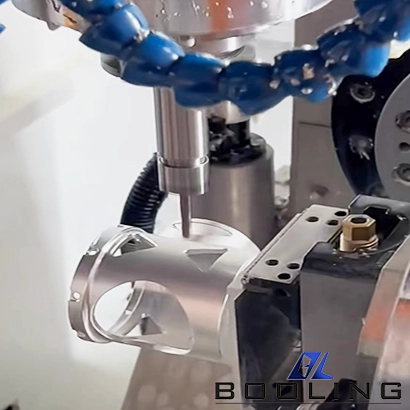
Rough machining
Rough machining is completed on CNC machines with one-time clamping for cavity blocks to minimize cumulative dimensional errors.
Precision finishing
High-speed CNC is adopted for finish machining, securing final cavity precision within ±0.03 mm.
Corner radius And ribs
EDM is applied for radii and rib features, enabling minimum internal sharp corner of R0.18 mm.
Through-holes And slots
Wire EDM (precision ±0.01 mm) is used for through holes and slots to guarantee accurate alignment between ejector pin holes and cooling channels.
Deep holes
Deep hole drilling with 370 mm stroke drills processes straight cooling holes in thick mold plates
How Long Does It Take?
Day 1–3
Day 4
Day 5–15
Day 16–30
Day 31–45
Day 46–55
FAQ for Rice Cooker Mold
Booling can provide the most common questions about purchasing rice cooker molds. Users can learn more about molds through the FAQs, or contact our engineers for one-on-one communication.
Processing of Rice Cooker Mold
Booling provides the design and processing of all rice cooker component molds. We have senior designers and professional engineers to achieve fast response.
- The shapes of rice cookers are diverse and complex, including round, square, or special geometric shapes, and the mold design is complex and exquisite. Our designers fully study and analyze the structure of the sample, accurately design the mold cavity, and achieve accurate reproduction of rice cooker products
- The quality of the mold directly affects the uniformity of the wall thickness of the rice cooker, the effect of the user’s cooking food, and the overall strength of the product
- According to the components and functions of the rice cooker, choose the appropriate processing steel and plastic materials. When designing the mold, you need to consider the shrinkage rate of the material and reserve the shrinkage amount
- The parting surface should be designed in a position that is convenient for product demoulding to prevent damage to the components when the product is demoulded. For the selection of the gate position, the wall thickness and size of the product should be considered. You can consider using a point gate or a latent gate to ensure that the material can evenly fill the entire cavity
- Reasonably design the hot runner system to shorten the flow path of the plastic and reduce the loss of pressure and heat. Adopt efficient cooling methods to ensure uniform cooling; select appropriate demoulding methods according to the size and shape of the product, such as push plates, push rods, sliders, inclined ejectors, etc., to ensure smooth demoulding
Types of Rice Cooker Mold
Booling provides molds for rice cooker shells, liners, control panels, handles, bases, etc., to achieve one-stop matching of rice cooker parts.
- Shell: The shell of rice cookers has various shapes and has high requirements for aesthetics. It needs to have certain high-temperature resistance, aging resistance, and biocompatibility. Mold production can accurately reproduce the shape of the product and achieve precision processing
- Liner: The liner of the rice cooker is in direct contact with food, and the material needs to be safe, corrosion-resistant, and heat-resistant. Booling can provide inlay production services to meet the needs of scale lines, logos, and other patterns inside the liner
- Control Panel: The control panel has multiple buttons, which need to have a size that is completely consistent with the design and sample and a good touch, and needs to have a quality that can withstand multiple presses
- Handle: The design of the handle needs to be in line with human factors engineering, comfortable to hold, and non-slip
- Base: The base needs to be designed according to the size and size structure of the rice cooker. The base of a heavy rice cooker may need to be designed with reinforcing ribs to ensure the stability and strength of the overall product