
Home > Logistics Mold > Pet Crate Mold
Pet Crate Mold
Details
Model:
Booling-Pet Crate Mold-1
Mold Steel:
45#, P20, 718, 2738, H13, SKD11, S136, 7075AL, 6061AL, beryllium bronze, etc.
Plastic Material:
PP/PE
Mold Base:
LKM, Booling standard
Origin:
China
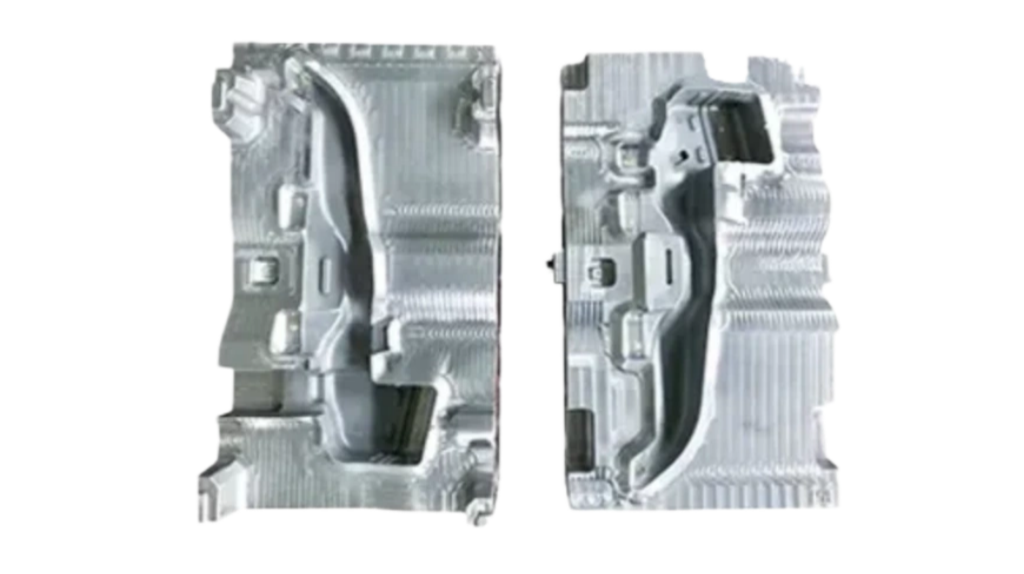
The design of the pet crate mold is complex, with multiple parting surfaces and complex demoulding mechanisms. When designing pet crate molds, it is necessary to consider the needs of pets and provide a certain degree of comfort and breathability. Booling mostly adopts rounded and chamfered designs to ensure the safety of pets while providing a large activity space to meet the requirements of pets of different sizes. We provide molds for pet airline crates, travel boxes, and other models to meet the needs of different manufacturers.
Application:
- Pet Crate
- Injection Molding
Related Hot Products
Technical Parameters Of Pet Crate Mold
The pet crate molds manufactured by Booling combine appearance and practicality with high precision and safety, suitable for the life and transportation of pets.
| Number of cavities | 1 or multi-cavity |
|---|---|
| Process type | Injection molding |
| Steel hardness | HRC28-HRC60 |
| Mold heat treatment | Vacuum quenching, tempering, nitriding, etc. |
| Mold life | 500,000-2,000,000 times |
| Mold size | Depends on pet crate design and injection machine |
| Mold weight | Depends on pet crate design and injection machine |
| T1 | 30-60 days |
| Processing method | Grinding machine, drilling machine, CNC, EDM, high-speed finishing, deep hole drilling, wire cutting, etc. |
| Design software | AutoCAD, UG, Moldflow |
| Injection runner | Cold runner/hot runner |
| Injection gate | Direct gate, point gate, latent gate, fan gate, bull-horn gate, etc. |
| Sample quantity | 3-5 pieces |
| Processable surface roughness | 0.8μm |
| Dimensional accuracy | ±0.02mm |
| Quotation method | Send samples, send sample pictures and dimensions, pet crate 3D drawings. |
| Mold packaging | Wooden box |
| Mold accessories | Free |
| MOQ | 1 piece |
| Ejection method | Ejector, stripper, etc. (using hydraulic, cylinder, air valve, etc.) |
| Price Term | FOB, CIF |
Custom Cooling Circuit Design for Thin-Grid And Thick Load-Bearing Walls
For thin-wall grid areas
Dense cooling channels of Φ8mm diameter are arranged with spacing ≤25mm, improving heat exchange efficiency by 40%.
For thick-wall load-bearing sections
Φ12mm cooling holes are drilled to the core of thick walls via deep hole drilling (max depth up to 400mm) to eliminate uneven cooling where outer surface cools down while inner core remains overheated.
Flow Balance Test
All cooling circuits undergo flow balance testing before mold closing to guarantee temperature difference within ≤2°C for each independent loop.
Surface Finishing Options for Pet Crate Molds
1.Project Evaluation And DFM Analysis
We review customers’ component drawings and carry out DFM (Design for Manufacturability) analysis to confirm mold construction, cavity quantity and mold steel specifications.
2.Mold Design
Booling engineers generate 2D assembly drawings and 3D mold models with professional CAD/CAM software. Drawings require customer approval prior to machining to confirm proceeding with subsequent procedures per client’s requirements.
3. Raw Material Preparation
Source required raw materials including mold steels such as S136 and 718, then perform rough machining for mold bases and mold inserts.
4. Precision CNC And 5-Axis Machining
Adopt five-axis machining for finish milling, turning and contour machining of mold core and cavity to ensure outstanding machining precision.
5. EDM And Wire Cut Machining
EDM is used to machine intricate micro features that cannot be processed by conventional CNC.
6.Surface Treatment And Polishing
Implement polishing, nitriding or customized surface finishing treatments as required.
7. Mold Assembly And Fitting
Complete full mold assembly on injection molding machines; assemble all mold components and install ejection systems, cooling circuits and guide assemblies.
8. Injection Mold Trial And Modification
Mount the mold onto an injection machine for trial molding. Inspect dimensional tolerance and surface finish of molded samples. Modify mold structures against defects until approved samples are obtained to customer satisfaction.
9. Final Inspection And Delivery
Conduct full dimensional inspection with CMM (Coordinate Measuring Machine) against engineering drawings. After dimension verification, arrange packaging and shipment.
Steel Selection Guide for Pet Crate Molds

P20
Hardness HRC28~32. This cost-effective mold steel works well for prototype and small-batch orders with a service life below 300,000 shots, the top pick for clients aiming to cut mold development cost.
718H
Hardness HRC33~38. A medium-grade steel widely adopted for standard logistics crate production, lasting 300,000 to 800,000 molding shots.
2738
Hardness HRC33~38. Same medium hardness as 718H but with superior wear resistance, capable of 500,000 to 1,000,000 molding cycles.
S136
Pre-hardened to HRC48~52 as premium steel. Suitable for crate molds for food-grade or corrosive plastics, with a service life exceeding 1,000,000 shots.
Related Automotive Blow Molds
DFM Report
HDPE coolant circulation pipe molds — Φ20–Φ50 mm range, high-temp resistant design up to 120°C.
Complete 3D mold design drawings alongside Moldflow simulation report
Complete 3D mold design drawings alongside Moldflow simulation report, which marks air trap locations, predicted weld line positions and product warpage tendency.
Actual machining photos and onsite videos
Weekly production progress report with workshop machining photos and short videos.
Full set of trial-run documents
Molding parameter datasheet, full-scale CMM dimensional inspection report plus high-definition mold trial videos
Full Mold Component List
A detailed list covering mold base, cavity/core inserts, ejection parts, cooling accessories and standard guiding components.
FAQ for Pet Crate Mold
Booling can provide the most common problems in purchasing a pet crate mold. Users can learn more about molds through FAQ, or contact our engineers for one-on-one communication.
Performance Requirements for Pet Crate Mold
As a tool for living and transporting living things, pet crate molds need to have some special properties.
- Corrosion Resistance: The pet crate may be in direct contact with the pet’s feces and food residues, and may be disinfected at any time. It needs to have excellent corrosion resistance to prevent rust or corrosion on the surface
- Weather Resistance: It needs to have a certain weather resistance and is not affected by thermal expansion and contraction to ensure the stability of quality
- Wear resistance: The pet crate has a certain wear resistance to prevent pet scratches from affecting product quality. In addition, the processing mold also needs to choose steel with a certain wear resistance to ensure that the mold can withstand frequent opening and closing of the mold
- Dimensional Stability: During long-term use, the mold should remain stable and will not affect the processing accuracy of the pet crate due to factors such as aging and wear of the material
- High Precision: Since the pet crate needs to be matched with other metal products, it needs to have a higher precision to ensure the subsequent assembly accuracy
Processing Requirements for Pet Crate Mold
The structure of pet crate molds is special and complex. Booling designers will carefully study every detail and structure to ensure the production of high-quality products.
- The pet crate has multiple irregular surfaces and internal structures, and the design of the parting surface is relatively complex to ensure that the plastic melt can evenly fill every corner of the cavity
- The pet crate is large in size and is prone to uneven wall thickness defects during processing. Booling optimizes the mold cooling system, increases the diameter and number of cooling water channels, reduces product internal stress, and avoids deformation
- To ensure the transportation and life safety of pets, pet crate molds mostly use rounded and chamfered designs, which will greatly increase the difficulty of demolding. Booling uses more efficient demolding mechanisms, such as push plate demolding, slider demolding, etc., to improve demolding rate and demolding integrity
- The pet crate has high requirements for appearance. Booling will conduct strict quality inspection and performance optimization, such as precision, hardness, surface roughness, etc. Test molds are carried out to continuously optimize process parameters, mold structure, etc. to produce high-quality pet crate products