
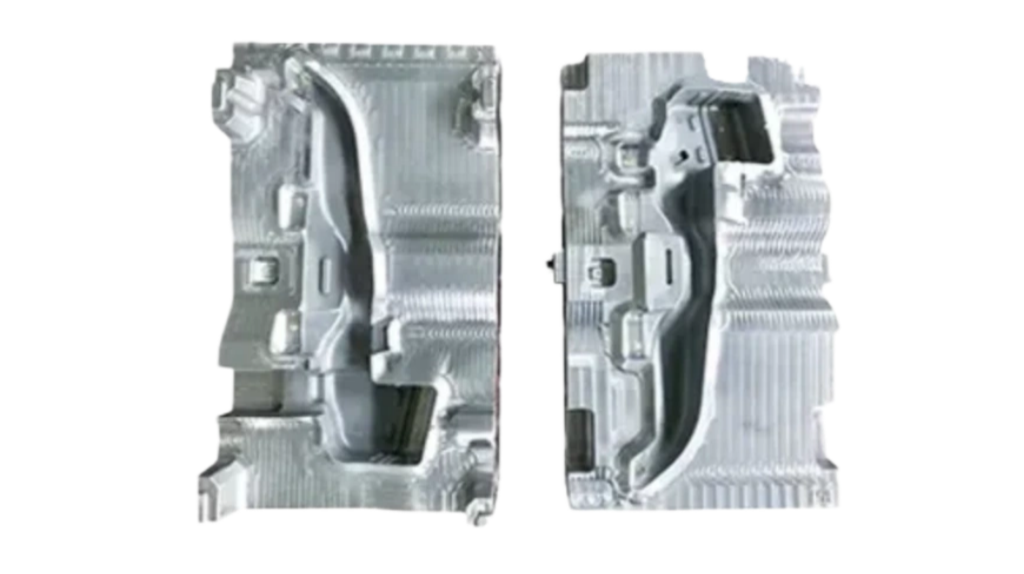
Home > Blow Mold Service > Automotive Blow Mold Manufacturer
Automotive Blow Mold Manufacturer — Custom Extrusion Blow Molding Tooling from China
Automotive blow molds for fuel tanks, air ducts, coolant reservoirs & fluid handling components. HDPE & multi-layer EVOH extrusion tooling. Conformal cooling cut one customer’s drum mold cycle from 95s to 78s.
- ISO 9001:2015
- Trusted by Tier 1
- DFM + Moldflow Simulation Included
- Quote Within 1 Working Day
- CMM Inspection Report with Every Mold
Automotive Blow Molds Manufacturing
A chemical drum plant in Germany came to us with a number. 95 seconds. That was their cycle time on a 220L HDPE drum mold — a mold they’d been running for about four years. The cycle was consistent. The parts passed inspection. But their production targets had shifted and they needed more throughput without buying a second machine.
We pulled the mold design apart and found the issue in the cooling layout. Straight drilled channels. Clean workmanship. But the base of the drum — the thickest section of the part, where material accumulates at the bottom of the parison — had a hot spot roughly 80mm in diameter. The nearest cooling channel was 35mm away. That zone was staying hot, slowing down the entire cycle.
We redesigned the cooling with conformal channels following the base contour. You could hear the difference when we ran the first trial — that steady hiss of cooling water moving through channels that actually reached the hot zone, pulling BTUs out of the steel at a rate the old straight channels never could.
First T1: 82 seconds. We tuned the parison programming, adjusted the cooling water temperature down 3 degrees, ran it again. 78 seconds. Seventeen seconds off their original cycle. Across 300,000 drums per year, that’s roughly 1,400 hours of recovered production capacity. The mold cost paid for itself in under eight months.
They’ve ordered three more molds from us since then. Not because we’re the cheapest. Because we showed them the math.
Performance Comparison
| Mold Type | Extrusion blow, two-half split construction |
| Parting Line | Straight or 3D-optimized curved surface (CAD designed) |
| Wall thickness tolerance | ±0.15 mm (verified by ultrasonic scanning) |
| Surface Finish | Polished to Ra 0.4 / VDI 3400 texture available |
| Cavity Inspection | Each mold ships with a CMM report |
| Mold Life | 300K–500K (P20) / 800K+ (S136) / 1M+ (H13 with nitriding) |
| Lead Time | 50–70 days for standard molds; 45 days for rush air-duct jobs |
| Deliverables | Full mold assembly + CMM report + maintenance manual + spare parts kit |
Mold Steel for Automotive Blow Mold

AL 7075-Lightweight Tooling
When speed and cost matter more than million-cycle durability, we offer AL 7075 aluminum tooling.
- AL 7075 is a high-strength aerospace-grade aluminum alloy with excellent machinability. It allows us to produce prototype blow molds significantly faster than steel — ideal for:
Design validation and fitment testing before committing to production steel
Low-volume production runs (up to 10,000–20,000 cycles)
Bridge tooling while steel molds are being manufactured
Oversized parts where mold weight is a handling concern
- Specifications:
Hardness: ~150 HB (T6 temper) –
Lead time: 15–25 days (vs. 50–70 days for steel)
Cost: 40–60% lower than P20 steel tooling
Best suited for: HDPE, PP parts with moderate wall thickness
Note: AL 7075 molds are not recommended for abrasive or glass-filled materials. For production volumes exceeding 20,000 parts, we recommend upgrading to P20 or 718 steel.
P20-Industry Standard
P20 is the most widely used mold steel for automotive blow molding — and for good reason. It delivers a proven balance of machinability, polishability, and service life at a competitive cost.
- When to choose P20:
Production volumes of 300,000–500,000 cycles
Standard automotive parts: air ducts, spoilers, coolant reservoirs, side steps
Parts that don’t require mirror-polish surface finish
Projects where cost efficiency is the top priority
- Specs:
Hardness: 28–32 HRC (pre-hardened, no post-machining heat treatment needed)
Polishability: Good — achieves Ra 0.4 surface finish
Weldability: Excellent — easy to repair and modify
Lead time: 50–70 days for a complete mold
> 85% of our automotive blow molds are built on P20. It’s the safe, proven choice.
1.2738-Higher Requirment
1.2738 is our upgrade recommendation when the part demands higher wear resistance, better polishability, or longer mold life than P20 can offer.
When to step up to 1.2738:
Production volumes exceeding 500,000 cycles
Parts requiring high-gloss or textured Class-A surfaces
Components with complex geometry where mold wear would cause dimensional drift
Fuel tank shell, Side step blow molds (Automotive exterior parts surface)

Upload your CAD models today, and our engineering team will run a complete DFM and mold flow simulation for you. Let’s catch the thinning and stretching risks before the tool hits the CNC machine.
Automotive Blow Molds We Build

- Automotive Water Filler Pipe Mold
Water filler pipes, expansion tanks, and washer fluid reservoirs. These parts operate in hot, vibrating, chemically aggressive environments.
PP for heat resistance / HDPE for chemical compatibility
Neck thread inserts — hardened, independently replaceable
Dimensional stability verified by CMM inspection

- Air Duct & HVAC Blow Molding
Turbo intercooler pipes, HVAC distribution ducts, clean-air intake runners. Complex routing that 2D extrusion can’t handle — we use 3D blow molding.
Internal surface polished to SPI A-2 to reduce air turbulence
Wall thickness tolerance: ±0.15 mm verified by ultrasonic scan
Integrated mounting bosses and ribbing — no secondary operations

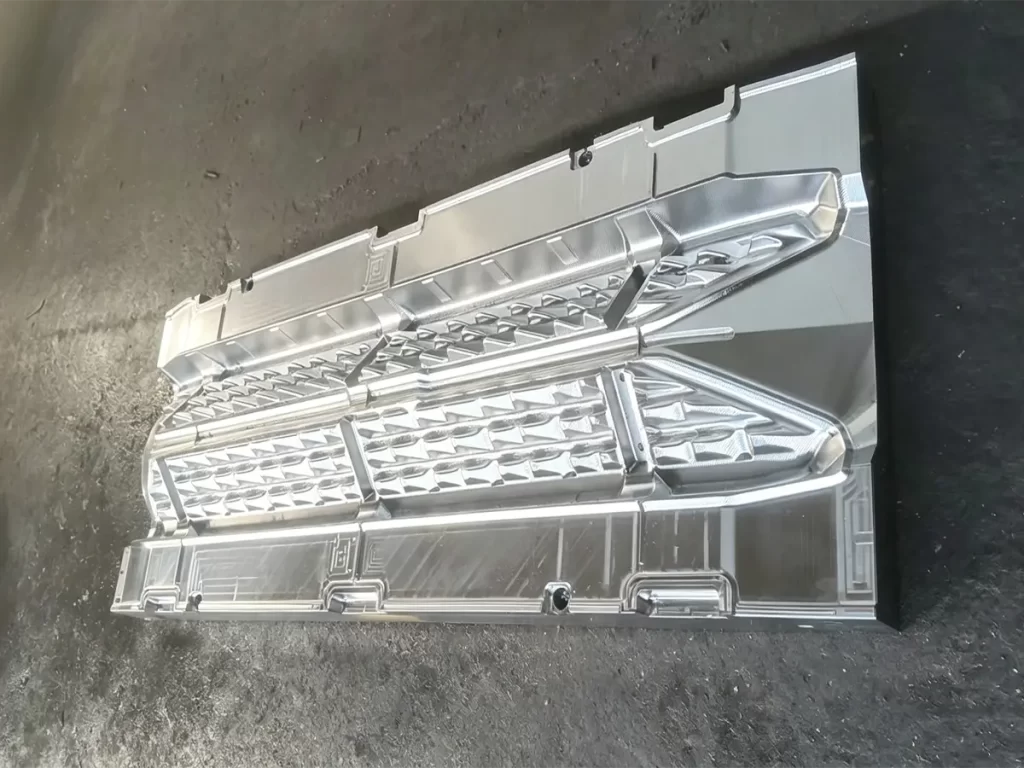
- Automotive Rear Spoiler Mold
Rear spoilers, diffusers, and exterior aerodynamic trims.
Class-A surface finish — visible parts that directly affect vehicle appearance.
Mirror-polished cavities for high-gloss finish
Gas-assisted cooling channels to reduce cycle time
Material flexibility: ABS, PP
- Automotive Side Step Mold
Side steps, running boards, and load-bearing exterior trims.
High impact resistance — these parts take repeated foot loads and road debris.
P20 / 718 steel standard, H13 + nitriding for high-volume programs
Reinforced pinch-off zones to handle structural loads
Textured surface options — anti-slip, matte, or grained finish
Automotive Blow Molds Cases
Automotive blow molds account for ~70% of our production. From fuel systems to exterior trims, here’s what we build most — and what you can expect from our molds.
Fuel Tank Molds
Fuel tank blow molds from 5L motorcycle tanks to 120L multi-layer EVOH truck tanks. Monolayer HDPE for standard applications. Six-layer co-extrusion with EVOH barrier for emission-regulated markets. The pinch-off weld on a fuel tank runs around the entire perimeter — several meters of seam that has to hold pressure. We use H13 with gas nitriding in the pinch-off zones. Routinely passes a million cycles.
Air Duct & Intake Molds
Air duct and intake tooling for turbo intercooler pipes, HVAC distribution ducts, clean-air intake runners. 3D blow molding for complex routing that 2D extrusion can't handle. Internal surface finish matters here — turbulence inside an intake duct costs horsepower. We polish intake cavities to SPI A-2 as standard.
Coolant Reservoirs & Fluid Handling
Coolant overflow bottles, washer fluid reservoirs, expansion tanks. These parts live in hot, vibrating, chemically aggressive environments. PP for heat resistance. HDPE for chemical compatibility. The neck threads are usually the tightest tolerance on these molds — we use hardened insert rings that can be swapped independently when they wear.
What Makes an Automotive Blow Mold Different
Automotive tooling runs harder than almost any other blow mold application. Three shifts. Minimal downtime. The consequences of a failure aren’t just scrap parts — they’re line stoppages that cost thousands per hour.
Cycle time is everything
On a mold running 300,000 cycles a year, a 3-second difference per shot is 250 hours of production. We optimize cooling for every automotive mold. It's usually the biggest lever on total cost of ownership.
Weight consistency drives material cost
Automotive programs buy resin by the railcar. A 5-gram variation on a 500-gram part adds up to tons of extra material per year. We target tight weight control through repeatable parison programming and uniform cooling.
Pinch-off integrity is non-negotiable
A fuel tank that leaks at the weld line isn't a quality issue. It's a recall risk. We use double-angle pinch-off designs with relief flash pockets, and every tank mold goes through pressure decay testing on T1 samples before shipping.
Here’s the thing about automotive blow molds: the simulation gets you 90% of the way there. The last 10% comes from trial and adjustment. Anyone who tells you their simulation is perfect hasn’t run enough molds.
Mold Steel for Automotive Blow Mold
What's the typical lead time for an automotive blow mold?
Can you build multi-layer barrier molds for fuel tanks?
Yes — most commonly 6-layer EVOH barrier for emission-regulated markets. Independent parison thickness control per layer, validated through co-extrusion flow simulation.
What blow molding machines are your molds compatible with?
Our molds are designed to fit all major extrusion blow molding machine brands, including:
Kautex Blow Machine
Bekum Blow Machine
Magic MP Blow Machine
Milacron Blow Machine
Jomar Blow Machine
Sidel Blow Machine
We design the mold base, clamp system, and parison programming interface to match your specific machine. Send us your machine model and platen drawing — we’ll confirm compatibility before production.
Do you provide mold warranty and after-sales support?
Yes. Every BOOLING blow mold comes with:
- 12-month warranty** against manufacturing defects
- Free spare parts kit** (o-rings, seals, heating elements) with every mold
- CMM inspection report** for every cavity before shipment
- Remote troubleshooting** via video call
- Wear part replacement** at cost price, even years after delivery
If a mold fails due to a manufacturing defect, we repair or replace it at no cost.
Can you support low-volume trial runs or prototype molds?
Yes. We offer two fast-track options for low-volume validation:
AL 7075 prototype molds** — 15–25 day lead time, 10,000–20,000 cycle life, 40–60% lower cost than steel
Bridge tooling — steel mold for initial validation while production mold is in manufacturing
Many customers use a prototype mold to validate fitment and wall thickness before committing to full production tooling.
What information do you need to provide a quote?
To give you an accurate quote within 1 working day, please send:
- 3D drawing (STP/IGES/SLDPRT preferred)
- Annual volume(helps us recommend steel grade)
- Resin type (HDPE / PP / ABS / TPO / etc.)
- Mold machine model (if known)
- Surface finish requirement (gloss / texture / grained)
No drawing yet? Send a sketch or sample photo — we can help with DFM and design feedback.