
Home > Packaging Blow Mold Manufacturer
Packaging Blow Mold Manufacturer — Custom IBC, Jerrycan & Drum Tooling from China
Get instant online 3D printing service quotes on custom parts in dozens of plastic and metal materials. Order 3D printed items and get free shipping on all US orders. International prototype pricing includes tariffs. ISO 9001:2015, ISO 13485, IATF 16949:2016, and AS9100D certified. ITAR registered.
- Quote Within 1 Working Day
- IBC Tanks, Jerrycans (5L–25L) & Chemical Drums (30L–220L)
- Single & Multi-Cavity Extrusion Blow Molds
- DFM + Moldflow Included — CMM Report with Every Mold
- ISO 9001:2015 Certified
- Lead Time 25–50 Days
Booling Mold: Industrial Blow Molds for IBC Tanks, Jerrycans & Drums
Cavity count is often the first specification buyers check, but it isn’t always the biggest factor affecting part cost.Cavity count matters, sure. But on a packaging mold running 24/7, cycle time and flash control have more impact on your per-part cost than whether you’re running two cavities or four. A 3-second cycle difference, across a million shots a year, is over 800 hours of lost production. A poorly designed pinch-off at the handle junction that leaves flash on every part? That’s labor cost compounding with every shift.
At Booling Mold, we build packaging blow molds for the bigger stuff: IBC tanks, 5L–25L jerrycans, drums up to 220L, and industrial containers up to 1000L IBC. Not small bottles or pharma vials. These applications weigh a few tons per mold, cycle times run in dozens of seconds, and the engineering trade-offs actually matter — parison weight, cooling design, pinch-off integrity that decides UN drop testing.
Packaging Blow Molds We Build
We focus on mid-to-large packaging — the stuff where the mold weighs a couple tons and the engineering decisions actually move the needle on your production cost.
IBC Tank Molds — 1000L to 1250L
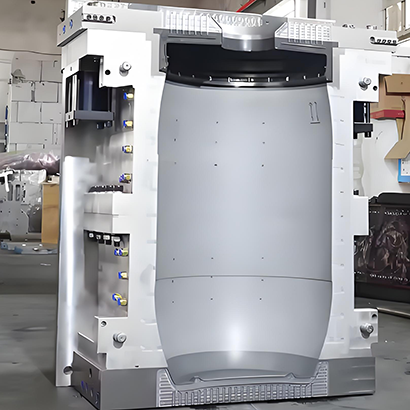
Intermediate bulk container molds — the biggest packaging blow molds we build. Single-layer HDPE for standard chemical transport. Double-layer with UV-stabilized outer skin. Multi-layer EVOH barrier for high-purity applications. The parison weighs around 15kg. The base cooling design determines whether your cycle is 120 seconds or 180. Large blow mold tooling at this scale needs conformal cooling and reinforced base plates — the mold alone weighs 4 to 7 tons.
Jerrycan Molds — 5L to 25L
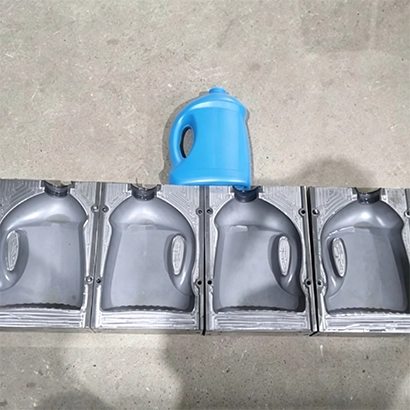
This is our sweet spot in packaging. The 5L to 25L jerrycan is the workhorse of industrial liquid packaging — stackable, durable, UN-certifiable. The handle junction is where most molds fail. The parison has to flow around that internal geometry, and flash accumulates at the pinch-off if the blade design isn’t right. We use contoured pinch-off blades. Adds machining time upfront. Pays for itself in reduced trimming labor within the first year of production.
We had a 20L jerrycan project where the customer’s existing mold was leaving a flash ridge at the handle that required a full-time operator just for trimming. One person. Eight hours a day. Cutting flash off jerrycans. We redesigned the pinch-off geometry and reduced the flash to the point where it could be removed by the automated deflasher that was already part of their line. The labor savings alone covered the mold cost in about 14 months.
Chemical Drum Molds — 30L to 220L
Tight-head drums with 2-inch and 3/4-inch bung openings. Open-head drums with removable lids. UN-certifiable for dangerous goods transport. The pinch-off weld around the drum perimeter runs several meters — every millimeter has to hold pressure under stacking and drop testing. We use H13 with gas nitriding in the pinch-off zones. Routinely passes a million cycles.
A drum plant in Germany came to us with a 95-second cycle on their 220L mold. We redesigned the cooling with conformal channels in the base — the thickest section and the thermal bottleneck. Got it to 78 seconds. Across 300,000 drums per year, that 17-second reduction recovered the mold cost in under eight months.
Multi-Layer Barrier Packaging Molds
For products needing oxygen, moisture, or chemical barrier properties — agricultural chemicals, food-grade containers, specialty industrial fluids. Multi-layer co-extrusion with EVOH or PA barrier layers. Independent parison thickness control per layer, validated through co-extrusion flow simulation.
What Matters in a Packaging Blow Mold
Cycle time
Packaging is a volume game. We optimize cooling for every packaging mold. It's usually the biggest lever on total cost of ownership — and the one most shops under-invest in.
Flash control
On high-volume packaging molds, flash is a hidden cost center. Every gram of trimmed flash is wasted material. Every second spent trimming is wasted labor. Our parting line and pinch-off design minimizes flash formation, especially at handle junctions and neck areas.
Weight consistency
When you're buying HDPE by the ton, part weight matters. A 2-gram variation on a 200-gram bottle adds up to 2 tons of extra material per million cycles. We target ±1.5% weight variation through validated parison programming and even cooling.
Neck finish machining directly affects seal integrity and reject rates.

We build HDPE and multi-layer EVOH molds.
Mold Steel for Packaging Tooling
Packaging molds run hard — often 24/7. Steel choice matters.

P20
P20 handles the majority of packaging mold production — 300,000 to 500,000 shots. For a jerrycan mold running 100,000 cycles a year, that’s 3 to 5 years before the cavity surface needs attention. Most packaging programs operate well within that window.
718 and 1.2738
718 and 1.2738 step up when the math changes — volumes past half a million, or packaging where surface finish affects brand perception. The cost difference from P20 is modest. For high-volume consumer packaging, it’s usually worth it.
H13 with gas nitriding
H13 with gas nitriding in the pinch-off zones and neck insert areas. On a jerrycan mold, the handle junction pinch-off takes the most abuse. On a drum mold, it’s the perimeter weld line. Nitrided inserts routinely pass a million cycles. Replaceable individually
S136 stainless
S136 stainless for food-grade or corrosive chemical packaging. The cost is about 40-50% above P20. For standard industrial containers running virgin HDPE, P20 is almost always sufficient. We won’t recommend stainless unless your application actually needs it.
Frequently Asked Questions
What's the typical cost of a packaging blow mold?
Single-cavity bottle mold: $5,000 to $15,000. Multi-cavity jerrycan mold: $15,000 to $35,000. 220L drum mold: $25,000 to $50,000. We quote within 1 working day.
How many cavities should my packaging mold have?
Single-cavity below roughly 100,000 parts per year. Two to four cavities above that. A two-cavity mold costs about 60-80% more than single-cavity, not double.
Can you build UN-certifiable packaging molds?
We design packaging blow molds to produce containers capable of passing UN certification. Certification is between you and your notified body.
What's the typical cycle time for a jerrycan mold?
20L HDPE jerrycan: roughly 45 to 60 seconds on a well-cooled single-cavity mold. Actual time depends on wall thickness, material grade, and cooling efficiency.
