
Home > Large Blow Mold Services for IBC Tanks & Industrial Containers
Large Blow Mold Manufacturing — Custom Industrial Tooling for IBC Tanks, Drums & Containers
Large blow molds for IBC tanks, chemical drums, and industrial containers ranging from 200L to 3000L.Each project includes DFM review and Moldflow simulation before machining starts to identify potential issues in parison distribution and cooling efficiency at an early stage.Full inspection records are provided for dimensional control and validation
- IBC Tanks, Drums, Water Tanks & Industrial Containers — 200L to 3000L
- DFM + Moldflow Included — CMM Report with Every Mold
- Single & Multi-Layer Extrusion Blow Molds
- Quote Within 1 Working Day
- ISO 9001:2015 Certified
- Lead Time 35–65 Days
- Taizhou City (Mold Town)
- 6100 m² Workshop
- 10+ Years Manufacturing
- 12-Month Warranty
- 24h Response
Technical Overview of Large-Scale Blow Molding Molds
Blow molding molds used for producing 1000L medium-sized chemical drums, large water tanks, and other hollow containers differ significantly from those used for small chemical drums. Three core distinctions set large blow molding molds apart from small chemical drum molds: parison stability, cooling system arrangement, and overall mold rigidity.
Improper cooling channel design, unstable parison extrusion parameters, or unreasonable pinch-off transition geometry can all negatively affect the impact resistance of the final product. Even if dimensional inspection results are within tolerance, cracking may still occur during low-temperature drop tests.
In the mass production of 1000L bulk containers, a common issue is that although all dimensions pass inspection, around 12% of products fail UN drop tests. Failure typically occurs at the bottom transition radius between the drum body and pallet interface. This is mainly caused by insufficient cooling coverage in this thick-wall transition area. During continuous production, this region remains hotter than other parts of the mold, creating a persistent heat accumulation zone. Over time, this leads to localized residual stress within the material.
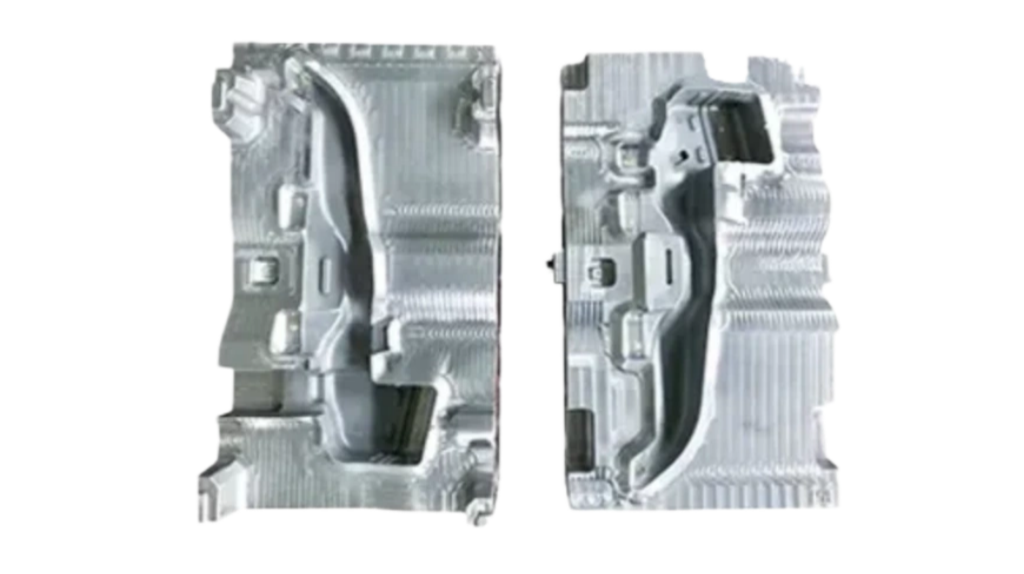
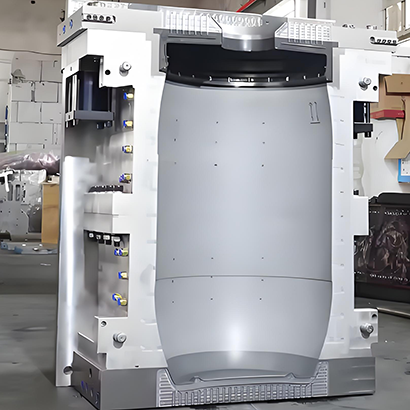
Large Blow Molding Mold Display
Customized for each project — We provide complete CAD data and DFM support tailored to your needs. Feel free to contact our team for inquiries.

What Makes a Large Blow Mold Different
For small chemical drum molds, the extruded parison weight is only around 200g, so gravity has little influence on melt distribution and wall thickness is easier to keep uniform. In contrast, large industrial molds handle parisons of 8–15kg, and the extrusion process lasts several seconds. The upper section cools and solidifies earlier while the lower section remains molten, so thermal differences already lead to wall thickness variation before mold closing.
In IBC mold design, some engineers tend to focus on overall thermal balance while overlooking the structural design of the pinch-off transition area. A straight pinch-off easily creates stress concentration and becomes a crack initiation point under impact load. Shaping this zone into a continuous gentle arc disperses weld-line stress and eliminates localized stress buildup. Only tiny geometric adjustments are needed to greatly boost the part’s low-temperature crack resistance.
A large mold cavity has 2 to 3 square meters of surface area. Cooling that much HDPE from 200°C to below 80°C takes time. Conformal cooling channels can cut cycle time 15-25%. On a mold running 50,000 cycles a year, that’s thousands of hours of recovered production capacity.
A complete large blow mold assembly weighs 4 to 8 tons. The mold base has to be rigid enough to prevent deflection under clamping force. We use thicker base plates and additional support pillars.
Large Blow Molds We Build
IBC Tank Molds — 1000L to 1250L
For medium-sized bulk containers, the most critical design requirement is the geometric optimization of the bottom transition radius. The cooling uniformity in this thick-wall region directly determines both cycle time and final impact resistance. Therefore, the primary focus is thermal and structural optimization.
Chemical Drum Molds — 200L to 220L
For chemical drums, production efficiency and cycle time reduction are key. Optimizing cooling systems and pinch-off structures can significantly shorten forming time and increase annual output. This is the main goal in continuous mass production environments.
Water Tank Molds — 500L to 3000L
This category represents the largest blow molding molds, with single cavities exceeding 2 meters in length. Independent zoned temperature control and cooling systems are essential for stable production. A single-loop cooling design cannot ensure consistent parison formation or stable product quality.
Looking for Large-Scale Blow Molding Solutions?
We specialize in heavy-duty blow molds for large parts. Upload your design and receive expert DFM analysis and pricing within 24 hours.
Mold Steel for Large Tooling
P20:P20 is commonly used as the base material for large blow molds, particularly in production ranges of 10,000 to 50,000 units per year. With typical service life reaching 300,000 to 500,000 cycles, it provides a balanced solution between cost and wear resistance for large structural tooling.
H13:For high-stress areas such as pinch-off zones and weld line regions, nitrided H13 steel is widely used for inserts. These areas are subject to concentrated mechanical wear and thermal loading. In most large molds, replacing localized inserts is more practical than reworking the entire cavity block once wear occurs.
S136:S136 stainless steel is reserved for corrosive or chemically aggressive applications. Given the machining complexity and material cost at this scale, it is only selected when corrosion resistance is a defined engineering requirement rather than a general preference.
Frequently Asked Questions
What's the largest blow mold you can build?
3000L water tanks with cavities over 2 meters. The limiting factor is usually your machine capacity.
How much does a large blow mold cost?
200L drum: $25,000 to $45,000. 1000L IBC: $40,000 to $65,000. 2000L+ water tank: $50,000 to $80,000+. We quote within 1 working day.
How long does a large blow mold take to build?
35 to 65 days from design approval. We’ll give a firm date in the quote.
Can you build multi-layer large blow molds?
Yes — 2-layer and 6-layer for IBC tanks and chemical drums requiring EVOH or PA barrier.
- Request a Free Quote/DFM
Respond within 24 hours · No spam · NDA available
By submitting, you agree to our privacy policy. We never share your data.
- Free DFM review with every inquire
- NDA available upon request
- No obligation — just a conversation
- Expert engineer assigned to your project