
Home > Large Automotive Blow Molding Mold Manufacturing Service
Large Automotive Blow Molding Mold Manufacturing Service
Model: BL2505160 | Die Ref: F5120S
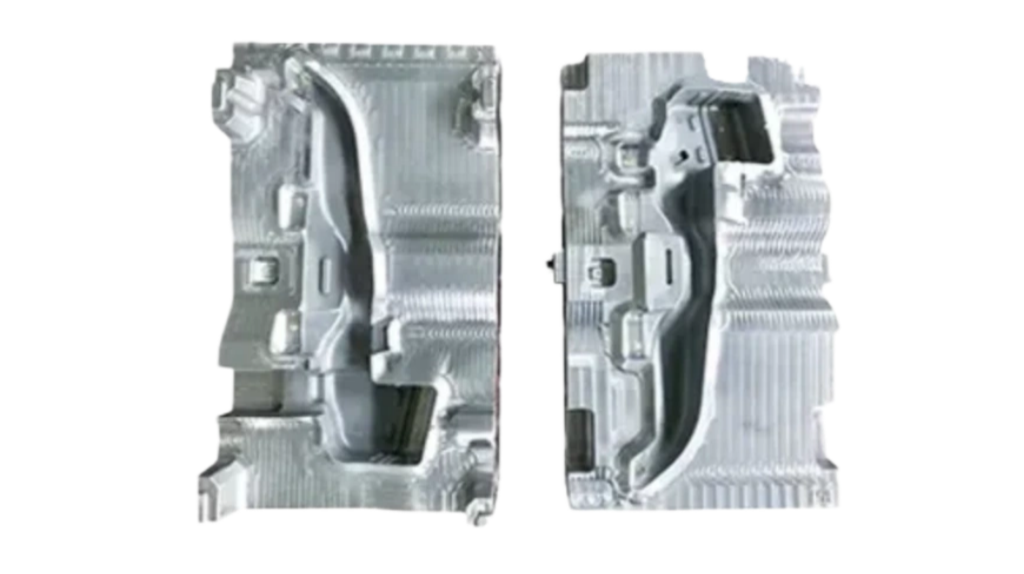
Booling provides customized manufacturing services for large automotive blow molding molds, including adjustments to parting surface design, cavity machining, cooling system layout and more. We help customers shorten mold development cycles, improve product surface finish and secure stable mass production performance.
- ISO 9001:2015 Certified
- CAE Simulation & Long Cavity Cooling Optimization
- Quote Within 1 Working Day
- Full After-sales Support
- 5-Axis Precision Machining for Large Auto Blow Molds
- 6100 m² Workshop
- 10+ Years Manufacturing
- 12-Month Warranty
- 24h Response
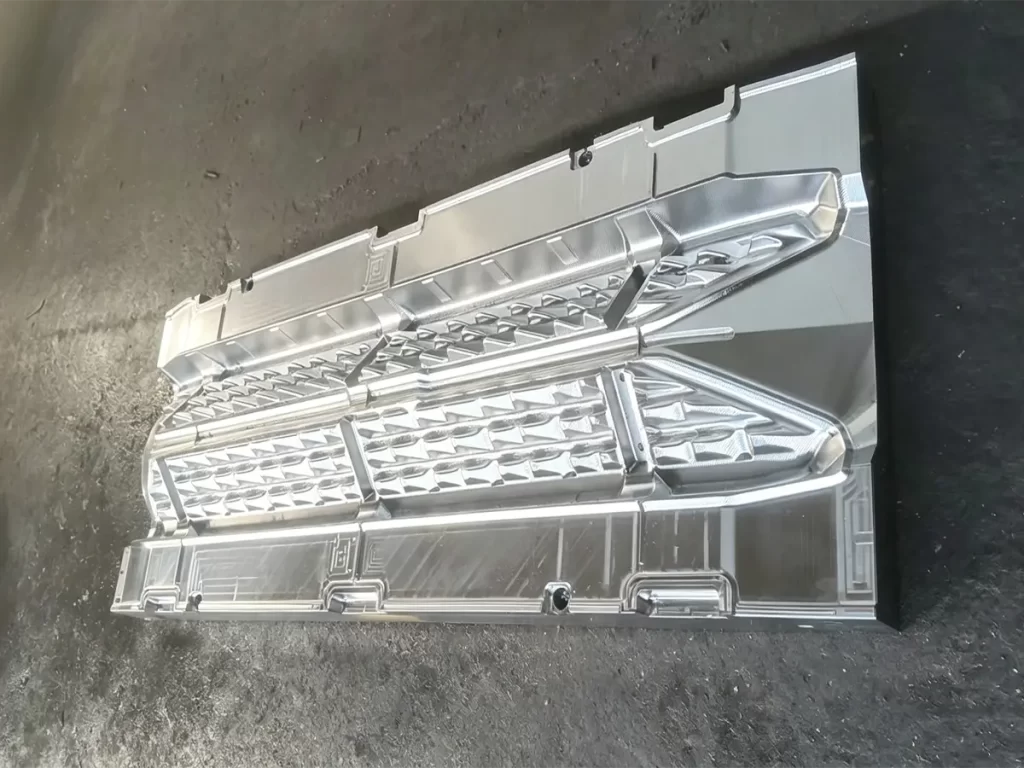
Large Blow Molding Molds for Automotive Components Manufactured by Booling
Automotive Roof Rack Mold
Automotive Rear Spoiler Mold
Automotive Air Duct Mold
Automotive Side Step Mold


Precision Assurance for Machining
| Equipment Type | Axis Count | Machining Travel | Machining Precision | Practical Application for Large Molds |
|---|---|---|---|---|
| Small 5-axis CNC | 5-axis | 500×400×400mm | ±0.005mm | Finish machining of pinch-off inserts, precision electrodes and small cores to guarantee fitting precision of small parts |
| Double-head 5-axis EDM | 5-axis | 3000×1500×800mm | ±0.015mm | Integrated EDM texturing for large-area cavities of extra-long workpieces. One-time clamping on a 3-meter worktable completes texturing of ultra-long curved surfaces |
| 3-Axis CNC | 3-axis | 410×410×410 mm | ±0.003 mm | Rough and finish machining of small precision parts such as mold inserts, ejector pin seats and slides |
| 4-axis Wire EDM | 4-axis | 400×300×300 mm | — | Cutting processing of insert cutting edges, guide sleeves and precision locating pin holes |
| Temperature Settings (°C) | |
|---|---|
| Sample #1 | Sample #1 |
| Sample #2 | Sample #2 |
| Sample #2 | Sample #2 |
| Sample #2 | Sample #2 |
| Temperature Settings (°C) | |
|---|---|
| Sample #1 | Sample #1 |
| Sample #2 | Sample #2 |
| Sample #2 | Sample #2 |
| Sample #2 | Sample #2 |
| Temperature Settings (°C) | |
|---|---|
| Sample #1 | Sample #1 |
| Sample #2 | Sample #2 |
| Sample #2 | Sample #2 |
| Sample #2 | Sample #2 |
Steel Grade Selection
| Plastic Additives & Physical Working Conditions | Target Output Volume | Recommended Base Steel for Cavity / Core | Recommended Steel for Pinch-off / Heavy Cutting Areas | Engineer’s Selection Logic (Technical Reason) |
|---|---|---|---|---|
| Standard general plastics (non-abrasive additives) | Within 300,000 shots | P20 | P20 | High overall cutting speed and low processing cost, effectively lowering initial basic manufacturing costs |
| Large extra-long / heavy large-section parts | Within 500,000 shots | 2738 | H13 (Composite Insertion) | 2738 features good hardenability with uniform core hardness of thick plates. Matching H13 at pinch-off positions prevents edge collapse and burr generation during long-term production |
| High glass fiber / inorganic filled plastics (heavy abrasion) | 500,000 – 800,000 shots | 2738 | H13 (Heavy Shear Resistance) | Glass fiber reinforced plastics cause severe cavity wear. 2738 serves as the base material, and H13 inserts at high-frequency extrusion pinch-off positions completely eliminate flash thickening |
| High gas corrosion / high appearance texture plastics | Within 500,000 shots | S136 | H13 | S136 delivers mirror-grade strong corrosion resistance to prevent rust and texture damage during ocean transportation and storage in humid workshops. H13 wear-resistant hard steel is adopted for pinch-off areas |
P20 (HRC28–32)
H13 (HRC48–52)
S136(HRC 34–38)
2738 (HRC29–33)


Customer Testimonial
The BL2505160 mold delivered exceptional cycle time reduction — 43 seconds vs. our previous 68-second benchmark. T1 samples passed on first try with all 12 dimensional checkpoints within tolerance.
—— John Doe
Technical Drawings & 3D Models
UNIQUE PER CASE — Drawing package provided per project. Contact sales for your DFM & CAD package.
Booling’s Delivery & Production Capacity Assurance Solution
One-on-one Dedicated Project Follow-up Service
A dedicated specialist tracks each mold throughout the entire process, synchronizing DFM evaluation, steel production scheduling, machining, T1 mold trial and shipment packaging. Customers do not need to coordinate with personnel from multiple departments separately.
Stable Production Capacity Support in Factory
The factory is equipped with multiple large 5-axis machining centers and large EDM equipment. Multiple sets of 3–8 ton heavy-duty large molds can be produced simultaneously, avoiding delays in mold processing caused by single machine occupancy and ensuring on-time implementation of customers’ mass production plans.
Project Cycle Control
Buffer cycles are reserved for each working procedure to avoid delays caused by conventional processing abnormalities:
- DFM Feasibility Evaluation: Complete analysis scheme issued within 3–5 working days.
- 3D Mold Structure Design: Drawings completed and confirmed within 2–3 weeks.
- Steel Procurement + Precision Machining: Finish precision machining within 4–6 weeks.
After mold assembly, in-house T1 mold trials are carried out, with complete rectification schemes for mold trial defects provided simultaneously.
All process nodes are clear and controllable, allowing customers to plan their own product mass production schedules in advance without passive waiting for construction periods.


Precision Assurance for Machining
| Equipment Type | Axis Count | Machining Travel | Machining Precision | Practical Application for Large Molds |
|---|---|---|---|---|
| Small 5-axis CNC | 5-axis | 500×400×400mm | ±0.005mm | Finish machining of pinch-off inserts, precision electrodes and small cores to guarantee fitting precision of small parts |
| Double-head 5-axis EDM | 5-axis | 3000×1500×800mm | ±0.015mm | Integrated EDM texturing for large-area cavities of extra-long workpieces. One-time clamping on a 3-meter worktable completes texturing of ultra-long curved surfaces |
| 3-Axis CNC | 3-axis | 410×410×410 mm | ±0.003 mm | Rough and finish machining of small precision parts such as mold inserts, ejector pin seats and slides |
| 4-axis Wire EDM | 4-axis | 400×300×300 mm | — | Cutting processing of insert cutting edges, guide sleeves and precision locating pin holes |
| Temperature Settings (°C) | |
|---|---|
| Sample #1 | Sample #1 |
| Sample #2 | Sample #2 |
| Sample #2 | Sample #2 |
| Sample #2 | Sample #2 |
| Temperature Settings (°C) | |
|---|---|
| Sample #1 | Sample #1 |
| Sample #2 | Sample #2 |
| Sample #2 | Sample #2 |
| Sample #2 | Sample #2 |
| Temperature Settings (°C) | |
|---|---|
| Sample #1 | Sample #1 |
| Sample #2 | Sample #2 |
| Sample #2 | Sample #2 |
| Sample #2 | Sample #2 |
Inspection & Mold Trial Equipment
| Equipment Type | Core Application |
|---|---|
| Coordinate Measuring Machine (CMM) | Full-area scanning inspection of cavity dimensions and wall thickness points, output dimension deviation reports. |
| Heavy-duty Blow Molding Trial Machine | In-house T1 mold trial verification, replicate parameters of customers’ mass production machines to debug parison and cooling processes. |
| Six-sided Rockwell Hardness Tester | Inspect overall hardness uniformity of steel materials. |
| Portable PMI Spectrometer | Non-destructive incoming inspection of steel materials, accurately distinguish P20/H13/S136/2738 material grades. |
| Steel Ultrasonic Flaw Detector | Screen internal interlayers and hidden cracks of steel materials to prevent scrapping after machining. |


T1 Trial Results
UNIQUE PER CASE — Drawing package provided per project. Contact sales for your DFM & CAD package.
T1 Qualification — All Checkpoints Passed
- Dimensional: All 12 points within ±0.01 mm
- Functional: 0.8 MPa leak test — passed
- Flash trim: Clean break, no burr
- Dimensional: All 12 points within ±0.01 mm
- Functional: 0.8 MPa leak test — passed
- Flash trim: Clean break, no burr
Performance Comparison
UNIQUE PER CASE — Drawing package provided per project. Contact sales for your DFM & CAD package.
| Aspect | BL2505160-F5120S | Industry Average |
|---|---|---|
| Cycle Time | Sample #1 | 65–70 seconds |
| Dimensional Tolerance | Sample #2 | Sample #2 |
| Mold Life | Sample #2 | Sample #2 |
| Auto Demolding Rate | Sample #2 | Sample #2 |
Process for Manufacturing Large Automotive Blow Molding Cavities by Booling
Step 1: DFM Review
Receive customers’ 3D models, raw material specifications and production equipment parameters. Mark weak wall thickness areas and weld line positions on drawings and conduct targeted adjustments. Our engineers issue complete DFM analysis reports to predict mass production risks and provide optimization schemes.
Step 2: Mold Design
Complete structural design of the entire mold using 3D CAD design software, including cooling water channels, ejector pin layout and pinch-off shape. The cooling system of large molds takes the longest processing time. Bumper molds are equipped with 8–14 independent water channels, and the flow rate of each channel requires precise adjustment to control temperature differences within 3℃ everywhere during molding.
Step 3: Steel Procurement & Incoming Inspection
Steel materials are sent to customers for confirmation before cutting. Steel for cavities and cores is purchased with machining allowance reserved. Each batch of steel undergoes inspection after arrival and is allowed to enter machining only after passing inspection.
Step 4: CNC Rough & Finish Machining
Booling first completes rough cavity cutting via 3-axis machines, then conducts precision curved surface processing with 5-axis equipment whose precision can be controlled at ±0.005 millimeters. If texture processing is required for product appearance, copper electrodes are manufactured first. After rough cavity machining, EDM discharge is performed to process textures of standard depth.
Step 5: Assembly & Mold Fitting
After mold assembly, blue oil is coated on the mold parting surface to test the tightness of parting surface fitting. After assembling ejector pins and slides, the mold is opened and closed without load more than 50 times to confirm smooth sliding without jamming. 12bar high-pressure water is injected into the mold cooling pipeline and held for half an hour to check for water seepage. In case of water leakage, water channel sealing is reworked.
Step 6: T1 Mold Trial
Install the mold on a blow molding machine and produce products with raw materials specified by customers. Record molding cycle and product weight throughout the process, scan 200 to 400 points with CMM to inspect wall thickness, and record various appearance defects. Sort out and send T1 mold trial reports and rectification schemes to customers.
Documents Delivered Along with Molds
Booling complies strictly with automotive industry standards for logistics protection and technical service specifications:
CMM Dimension Report
Material Certificates
Provide material certificates for mold bases, main cavities and pinch-off inserts as well as re-inspection results via incoming spectrometer. Inspection data of each batch of steel materials are fully retained.
Cooling Circuit Test Report
T1 Mold Trial Report
Mold Maintenance Plan
Transportation Protection Scheme for Export Molds
Anti-Rust Vacuum Sealing
Marine-grade anti-rust oil is sprayed on the surfaces of cavities, parting surfaces and insert slots of large molds. After anti-rust treatment, molds are placed into fully sealed thickened heavy-duty industrial vacuum bags filled with sufficient industrial desiccants. This isolates high salt spray and high humidity during ocean transportation, preventing rust and texture damage of cavity materials including P20, H13, S136 and 2738 during sea shipment, eliminating the need for subsequent rust removal and polishing.
ISPM 15 Fumigated Wooden Case Packaging
Molds are packed in ISPM 15 compliant heat-treated or solid wooden cases. The inner side of wooden cases is fully lined with high-density shock-absorbing foam to well protect precision parts vulnerable to collision such as EDM textured surfaces and thin-wall pinch-off inserts. TiltWatch tilt indicators and ShockWatch shock indicators are affixed outside wooden cases to record impacts and tilting during loading, unloading and transshipment throughout the whole process, enabling rapid liability tracing in case of logistics abnormalities.
Technical Drawings & 3D Models
UNIQUE PER CASE — Drawing package provided per project. Contact sales for your DFM & CAD package.
DFM report
- Wall Thickness Analysis:To check whether the wall thickness distribution of the product is uniform.
- Demolding:Whether the demolding process goes smoothly.
Material Selection: Able to select appropriate materials based on the product’s functional and appearance requirements.
Assembly: To check whether there are any assembly issues when the product is assembled with other components.
Mold flow analysis
Optimize gate location :Determines the best position for injecting plastic into the mold to ensure complete filling.
Predict filling patterns :Visualizes the advancement of the melt front, identifying potential air traps and weld lines.
Cooling behavior : Evaluates temperature distribution and cooling time to reduce warpage and shorten cycle time.
Identify shrinkage and warpage : Predicts areas prone to sink marks or deformation after cooling and solidification.
Evaluate packing pressure : Assesses the holding pressure maintained during cooling to compensate for material shrinkage, sink marks, dimensional inaccuracies, or internal voids.
Reduce mold trial iterations : Minimizes the number of physical mold trials, saving both time and cost.
Mold design
If the customer requires our mold design services, we can provide them with complete 3D mold structure drawings and 2D machining drawings.
Mold trial
Defect Diagnosis and Troubleshooting: Identifying various defect issues that occur during the trial molding stage and eliminating them.
Comprehensive Inspection: Performing dimensional accuracy measurements, appearance checks, material property tests, and assembly trials on the samples.
Performance Testing: Evaluating the flow rate and pressure of the mold’s cooling system, the filling balance of the mold, and other relevant conditions.
Recording: Documenting all key molding parameters for the first batch of samples produced.
Small-batch production and sample delivery
Quality Inspection: We will randomly sample products from each batch of small-scale production to conduct comprehensive dimensional accuracy measurements, appearance inspections, and material property tests.
Defect Handling and Improvement: If any defects occur during the production process (such as bubbles, warpage, dimensional deviation, etc.), we will immediately conduct a root cause analysis for the customer and adjust the mold manufacturing process and other means until the defects are eliminated.
Sample Delivery: According to the customer’s requirements, we will clean, deburr, and apply rust-proof treatment to some samples, and use shock-proof and anti-static packaging to ensure no damage during transportation.
The delivered documents include: sample inspection report (including key dimensional data, appearance photos, material certificate), small-batch production parameter record sheet, certificate of conformity and quantity list. If the mold has been adjusted, we will also attach a mold modification confirmation form.
After-sales service
- Technical Training Services:Our technicians have professional skills and relevant knowledge to support online mold maintenance guidance, conduct rapid troubleshooting, and assist in mold processing and processing of difficult-to-process engineering plastic raw materials.
- Regularly inspect and evaluate the mold :our after-sales personnel can understand the customer’s usage in a timely manner and make corresponding suggestions.
- Repair & Warranty:We guarantee the quality of molds and provide first-level maintenance and second-level maintenance services. If you encounter any problems within the warranty scope, we will provide accurate and correct repair services to ensure that customers have the shortest downtime and quickly re-enter the production process.


Cooperation Process for Custom Side Step Blow Molding Molds
+
You only need to submit part 3D drawings, annual output volume and vehicle model requirements.
duration: 3–5 days
+
Finalize mold price, trial shot quantity, delivery cycle and spare parts list with you.
From ~60% baseline → 30% improvement
+
Steel purchasing is initiated immediately upon receipt of deposit.
From ~60% baseline → 30% improvement
+
Mass production simulation debugging on trial machines, with retained CMM scanning reports of wall thickness and straightness.
duration: 3–5 days
+
You may witness on-site mold trial or receive shipped samples. Shipment of export molds is arranged after full qualification confirmation.
From ~60% baseline → 30% improvement
Booling After-Sales Support Service
Spare Parts Package
A complete set of large automotive blow molding molds is delivered together with spare parts including pinch-off inserts, blow pins, O-rings, water pipe connectors and zoning control valves, matched for conventional maintenance within 12 months, reducing waiting time caused by production line shutdown.
Remote Video Technical Support
In case of any sudden process abnormality on the production line, our project engineers will conduct on-site remote troubleshooting via video call immediately upon your contact, checking on-site equipment and mold status in real time. Assist you in adjusting parison curves and cooling zoning parameters to quickly restore the production line to normal mass production status.
Lifetime Cost-Price Supply of Wearing Parts
Even years after mold delivery, you can place long-term orders for consumable parts such as pinch-off inserts, blow pins and guide sleeves. We only charge the manufacturing material and basic processing costs of these parts, lowering your long-term maintenance expenses and losses caused by production downtime.
Mold Warranty
All molds manufactured by us come with a 12-month full mold warranty. For cavity abnormal wear, water channel seepage, parting gap deviation, pinch-off failure and other issues caused by our design, steel material and manufacturing processes, we provide free repair, spare part delivery and factory return overhaul & refurbishment as after-sales rectification services.
Drawing Revision Support
When OEMs revise duct geometry (typical 2D to 3D updates or wall thickness adjustments), we quote engineering modification costs based on a fixed rate instead of rebuilding from scratch.
Production Capacity Reservation
For long-term production customers, we reserve machine time on our EBM (Extrusion Blow Molding) production lines to support urgent trials in case of unexpected mold downtime.
Cooperate With Us
You may send product 3D drawings, annual output volume and raw material information to obtain mold solutions. The full set of services covers DFM simulation, integrated 5-axis precision machining, complete in-house mold trials, export ocean transportation protection and long-term process technical support, meeting mass production demands of various automotive exterior and blow-molded functional parts at home and overseas.
Custom Large Automotive Blow Molding Mold Solutions
Submit your part drawings or samples, and we’ll provide tailored quotation & DFM analysis within 24 hours.
- Request a Free Quote
Respond within 24 hours · No spam · NDA available
By submitting, you agree to our privacy policy. We never share your data.
- Free DFM review with every inquire
- NDA available upon request
- No obligation — just a conversation
- Expert engineer assigned to your project