
Home > Automotive Fuel Tank Blow Mold Manufacturer
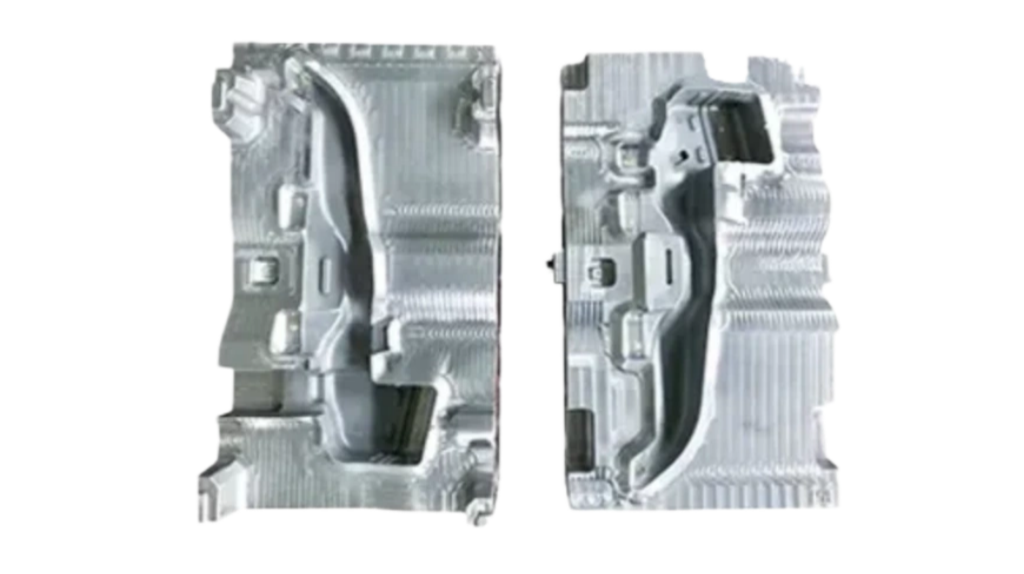
Automotive Fuel Tank Blow Mold Manufacturer — HDPE & Multi-Layer EVOH Tooling from China
Automotive fuel tank blow molds for HDPE monolayer & 6-layer EVOH barrier tanks. 5L to 120L extrusion tooling. H13 nitrided pinch-off inserts. ISO 9001 certified. Send your tank 3D model for a quote within 1 day.
- Lead Time 30–55 Days
- ISO 9001:2015 Certified
- HDPE Monolayer & 6-Layer EVOH Barrier Fuel Tank Molds
- DFM + Moldflow Included — Pressure Decay Testing on Every Mold
- List ItemQuote Within 1 Working Day

- 10+ Years Manufacturing
- 24h Response
- 12-Month Warranty
- 6100 m² Workshop
- Taizhou City (Mold Town)
Fuel Tank Blow Mold Engineering Case Study
At the early stage of the project, the customer requested full S136 stainless steel for the mold cavities. The main concern was that, during long-term extrusion blow molding of HDPE, corrosive volatiles released from the material could gradually damage the surface finish of standard mold steels.
Based on an annual production volume of 80,000 units, we initially recommended a more cost-balanced solution: P20 steel for the main cavity structure, with H13 nitrided inserts used in high-wear areas such as the pinch-off regions. This configuration is commonly used in fuel tank mold applications and is sufficient for stable long-term production.
If the entire cavity were made of S136 stainless steel, the overall tooling cost would increase significantly, resulting in lower cost efficiency for this production scale.
However, the customer still chose full S136 for the cavity due to concerns about potential wear issues based on previous experience.
After two years of production, feedback showed that the mold cavity has not exhibited any signs of corrosion or polishing degradation.
This case demonstrates that full S136 selection is mainly driven by the need for long-term production stability rather than immediate technical necessity.
Fuel Tank Molds We Build

HDPE Monolayer Tanks
The workhorse. 5L to 80L+. Passenger cars, motorcycles, ATVs, light commercial. P20 cavities with H13 nitrided pinch-off inserts handle 300,000 to 500,000 shots. For higher volumes, we move to 718 or 1.2738 — better wear resistance without the full stainless premium.
6-Layer EVOH Barrier Tanks
EPA, Euro 6/7, and China VI emission standards demand hydrocarbon barrier layers. Six-layer co-extrusion — HDPE outer, adhesive tie-layers, EVOH barrier, and inner HDPE — requires precise parison control. Each layer has independent thickness programming. The challenge: getting uniform layer distribution around complex tank contours. If the EVOH layer thins below a critical threshold anywhere on the tank wall, hydrocarbon permeation rates spike.
We validate layer distribution through co-extrusion flow simulation before cutting steel. Not perfect — the simulation assumes the parison hangs straight, and real parisons oscillate slightly during extrusion. But it catches 90% of the issues before T1.
Diesel & AdBlue Tank Molds
Diesel tanks. Urea/AdBlue tanks for SCR systems. These require chemical resistance beyond standard HDPE grades. We match mold steel and surface treatment to your specific polymer — specialized PP grades or reinforced HDPE with targeted chrome plating to prevent corrosion.
What Matters in a Fuel Tank Mold
P20
Suitable for single-layer fuel tank mass production, with a service life of 300,000 to 500,000 shots. For an annual output of 80,000 units, it can run stably for 4 to 6 years before cavity maintenance.
718
Used when annual output exceeds 500,000 units, or when clients want extended mold service life without switching to stainless steel.
S136 stainless stee
Restricted to high-wear pinch-off zones in the form of replaceable inserts for convenient later maintenance. The 0.2–0.3 mm nitrided layer withstands repeated clamping pressure.
H13 steel
Reserved for high-output programs or projects requiring extreme long-term stability. It delivers excellent corrosion resistance and sustained polishing finish but raises overall mold costs by 40%–50%. Material selection is always evaluated based on production volume and the client’s risk tolerance, rather than used as a default option.
Automotive Fuel Tank Blow Mold Manufacturer
Custom blow molding solutions for automotive fuel tank systems with strict requirements on structural integrity and dimensional stability.
Frequently Asked Questions
What's the difference between monolayer and multi-layer fuel tank molds?
Monolayer molds produce single-material HDPE tanks. Multi-layer molds produce 6-layer co-extrusion tanks with EVOH hydrocarbon barrier — required for emission-regulated markets. Multi-layer tooling costs more and takes longer to build. The payoff is emission compliance without post-molding treatment.
How long is the delivery time?
Pressure decay testing on T1 samples. The tank is pressurized to spec and held. Any pressure drop beyond the allowable limit means the pinch-off weld isn’t sealing. We don’t ship molds that fail pressure decay.
Can you build fuel tank molds with integrated component mounting?
Yes. Fuel pump flanges, sender unit mounts, vent valve bosses — we form these during the blow molding cycle using retractable core inserts. Eliminates secondary welding or drilling.
What's the typical lead time for a fuel tank blow mold?
30 to 55 days from design approval. Multi-layer EVOH molds run longer due to co-extrusion head integration and more complex parison programming validation.
- Request a Free Quote
Respond within 24 hours · No spam · NDA available
By submitting, you agree to our privacy policy. We never share your data.
- Free DFM review with every inquire
- NDA available upon request
- No obligation — just a conversation
- Expert engineer assigned to your project