
Home > Medical Backboard Mold
Medical Backboard Blow Mold Manufacturer — HDPE Spine Board Tooling from China
Custom blow molds for medical backboards & spine boards. HDPE single-piece extrusion blow molds with ±0.3mm wall thickness control. Full ISO 13485 material traceability. ISO 9001 factory in Taizhou, China.
- HDPE Single-Piece Extrusion Blow Molds
- ISO 9001:2015 Certified Factory
- Wall Thickness Control: ±0.3mm Across Full Surface
- Lead Time 35–55 Days
Not Just Numbers on a Drawing: Designing Blow Molds That Meet Clinical Safety Standards
A backboard that flexes too much during spinal immobilization isn’t a manufacturing defect. It’s a clinical risk.We didn’t fully appreciate this until a customer rejected our first T1 samples about three years ago. The wall thickness was within our quoted tolerance. The CMM report looked fine. But when their QA team loaded 250kg on the center of the board, the deflection hit 18mm — 3mm past their spec. The problem wasn’t the average wall thickness. It was the distribution. Too thin in the center third of the patient support surface. Too thick at the edges where it didn’t matter.
We’d programmed the parison assuming uniform stretch across the flat section. Reality: the center stretches more. Always does. We re-ran the simulation with corrected boundary conditions, adjusted the parison profile to shift more material into the center zone, and the second T1 passed at 11mm deflection. That mold has been running in production for three years now.
This is the kind of thing you learn when you build medical blow molds. The tolerances aren’t just numbers on a drawing. They’re about whether a paramedic can trust the equipment under a patient.
Medical Backboard Molds We Build
Standard Adult Spine Board Molds
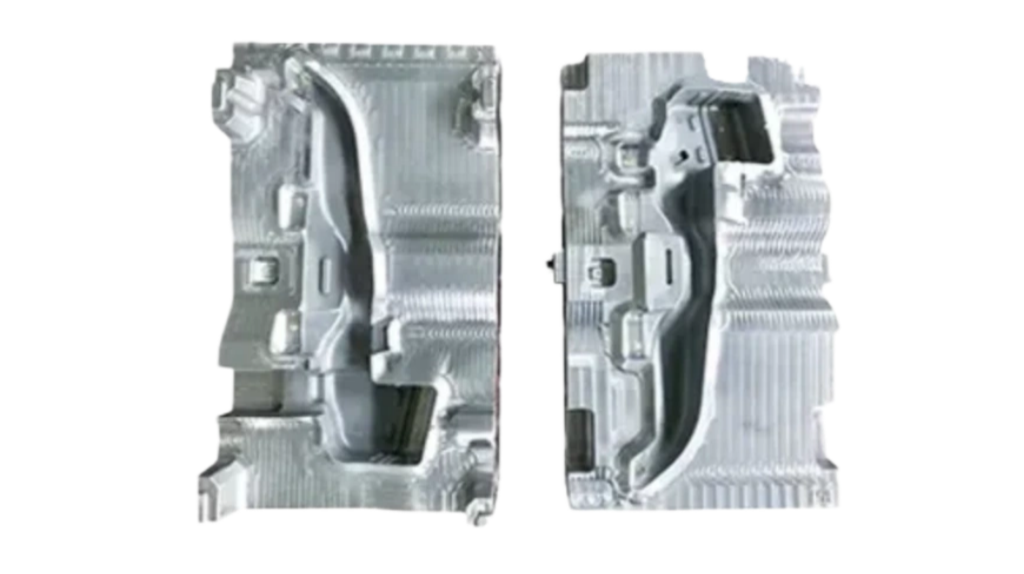
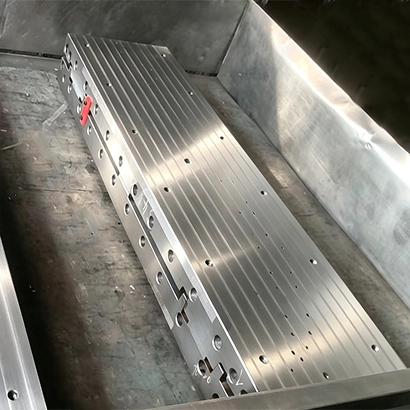
Full-size backboards. Typical dimensions around 1,830mm × 450mm × 50mm. Molded in one piece from HDPE — no joints, no welds, no mechanical fasteners. The mold forms integrated pin slots for restraint straps, handgrip cutouts, and structural runner channels on the underside. Single-cavity tooling with conformal cooling following the board contour. A standard backboard blow mould is nearly two meters long. The mold base alone weighs several tons. Rigidity matters — deflection under clamping force creates wall thickness variation. We use thicker base plates and additional support pillars compared to a typical industrial blow mold of similar dimensions.
Pediatric Spine Board Molds
Smaller boards for children and infants. Typical dimensions around 1,200mm × 350mm. Same HDPE construction, same single-piece blow molding approach. The thinner overall profile leaves less margin for wall thickness error — if anything, the engineering is tighter on pediatric tooling because the part is more sensitive to thickness variation.
Bariatric / Heavy-Duty Backboard Molds
Reinforced boards rated for 300kg and above. Thicker nominal walls — 5mm to 6mm instead of the standard 3.5mm to 4mm. The mold cooling design works harder because thicker walls hold heat longer. We use larger-diameter cooling channels and, where geometry allows, conformal circuits that follow the board contour. We had a bariatric board project where the customer wanted 6mm nominal wall but also wanted cycle time under 150 seconds. Those two requirements pull in opposite directions — thicker walls mean longer cooling. We got it to 148 seconds with aggressive conformal cooling in the base radius. Wasn't easy. Took some back-and-forth on the cooling channel layout.
X-Ray Compatible Backboard Molds
We can produce the finished stretcher bodies on our in-house blow molding machines. We also support small-batch production runs.Lower your risk.
Why Wall Thickness Control Matters More Than Anything Else
A spine board has a large, flat patient support surface — the worst possible geometry for uniform wall thickness in blow molding. The parison naturally thins as it stretches across that expanse. If the center drops below 3.0mm on a board spec’d at 3.5mm nominal, you’ll see excessive deflection under load.
Our approach:

Parison programming with multiple thickness zones
Thicker material in the center where stretch is greatest. Thinner at the edges where the mold closes sooner. We validate through CAE blow molding simulation before cutting steel. The simulation isn’t perfect — our IBC mold lesson taught us that sag matters more than the software predicts — but it catches 90% of issues upfront.
Ultrasonic thickness mapping on T1 samples.
We measure wall thickness at 20+ points across the board surface and provide the map in your inspection report. Target: ±0.3mm variation across the patient support area. On a 3.5mm nominal wall, your thinnest spot is at least 3.2mm.
Load deflection testing
Sample board loaded to rated capacity. Deflection measured at center. Must stay within customer-specified limit — typically under 15mm at 250kg center-loaded. We also do cold drop testing per customer spec: 2-meter drop at -20°C with distributed load. No cracking. No permanent deformation.
Custom Extrusion Blow Molding molds for medical backboards
Documentation for Medical Device Manufacturers
We conduct trial runs on extrusion blow molding machines using your specified materials. More than 10 critical dimensions are inspected via CMM, with wall thickness measurement reports provided.
- 3D CMM dimensional inspection report
- Wall thickness mapping from T1 trial samples
- Heat treatment records for H13 inserts and nitrided components
- Surface finish measurement reports
- Spare parts inventory with part numbers
- Material certificates for all mold steel — mill test reports with heat numbers
All filed under a unique mold serial number. If your FDA auditor needs traceability records three years from now, we can produce them.
Mold Steel for Medical Tooling
| Material | Specifications |
|---|---|
| P20 | Is our default for production backboard molds. It handles 300,000 to 500,000 shots with proper maintenance. For most medical device production volumes, P20 gives 15+ years of service. |
| S136 stainless | When the production environment demands it — humid conditions, aggressive cleaning protocols, or HDPE grades that are particularly corrosive during processing. We won't upsell you to stainless unless there's a real reason. |
| H13 with gas nitriding | For pinch-off inserts and pin slot forming mechanisms. These wear zones see the highest mechanical stress. Nitrided H13 routinely passes a million cycles. Inserts are individually replaceable. |
We tried plasma nitriding on a batch of medical mold inserts. The hardness numbers looked better on paper. But we saw premature wear on a couple of complex pin geometries where the case depth wasn’t uniform. Went back to gas. Costs slightly more per batch. Results are predictable. In medical tooling, predictable beats impressive on a datasheet.
Frequently Asked Questions
Can the mold produce boards that meet ISO 13485 requirements?
Standard extrusion blow molds: 50 to 70 days from design approval to T1 trial. Simple single-cavity molds can ship in 45 days. Complex multi-cavity automotive tooling with slides and conformal cooling: 12 to 16 weeks. We’ll give you a firm date in the quote — not a range that drifts later.
What wall thickness tolerance can you hold on a backboard mold?
Yes. We adapt the mold base, mounting pattern, blow pin interface, and ejection system to your machine — whether it’s a Kautex, Bekum, Uniloy, Jomar, or a domestic Chinese brand. Send us your machine’s platen layout and we’ll match it.
What’s included in the delivery?
Can you build a mold for a custom backboard size?
Yes — pediatric, adult, bariatric, or fully custom dimensions. Send your 3D model and we’ll provide DFM feedback specific to your geometry.
Are the boards X-ray compatible?
HDPE is naturally radiolucent. We can design the mold with non-metallic or easily removable inserts in critical imaging zones if your product requires full X-ray or CT compatibility.
Small-batch production and sample delivery
35 to 55 days from design approval to T1 trial. Complex molds with multiple moving pin inserts or conformal cooling may run longer.
Do you provide the HDPE resin?
We don’t supply resin — you source that from your preferred supplier. We can recommend HDPE blow-molding grades based on your impact resistance and low-temperature toughness requirements. Common grades we’ve tested: Sabic B1054, LyondellBasell Hostalen CRP 100, Chevron Phillips Marlex HHM 5502.
Can you match an existing board's texture and dimensions?
We match VDI texture specs for the cavity surface. Color is determined by your HDPE resin, not the mold. For dimensional matching, send the existing board or 3D scan data.
